How Much Does Text-to-Speech Cost? The Complete 2026 Breakdown
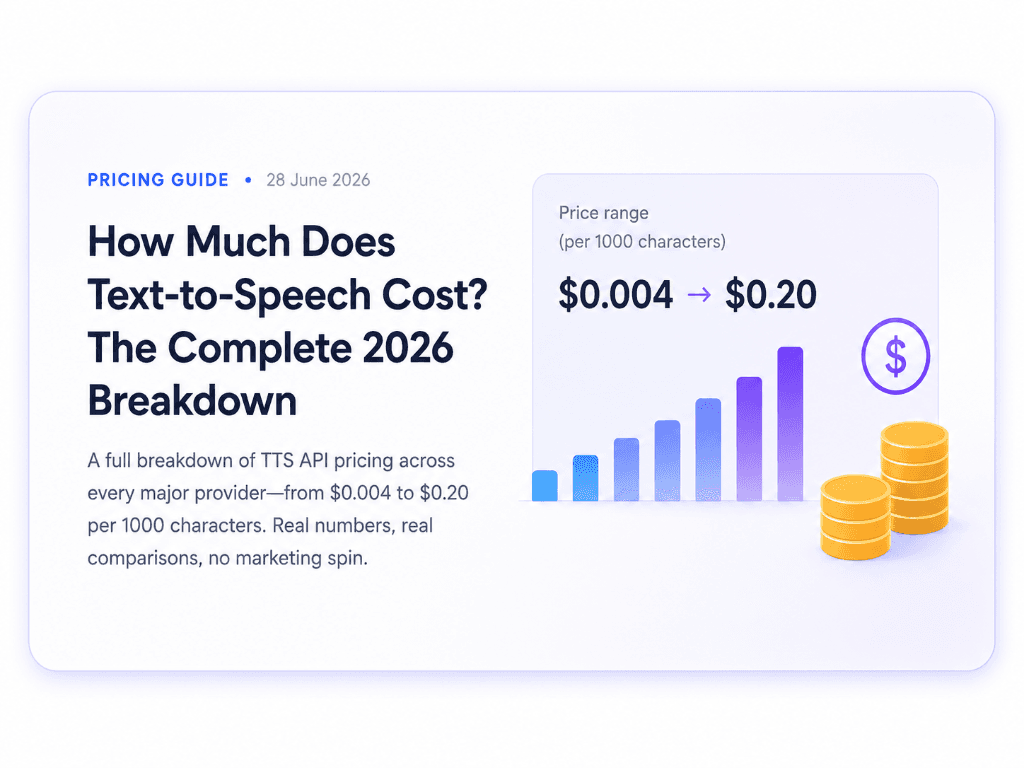
TTS pricing is deliberately confusing. Some providers charge per character, others sell monthly subscriptions, and the difference between the cheapest and most expensive option is a full 50×. This guide cuts through the noise.
Why TTS pricing is so hard to compare
If you've tried to figure out how much text-to-speech actually costs, you already know the frustration. Every provider uses a different pricing unit - characters, bytes, seconds of audio, or opaque monthly quotas. OpenAI charges per million characters on a pay-as-you-go model. ElevenLabs bundles characters into subscription tiers. Google has four different pricing levels within the same product. Amazon splits Polly into “Standard” and “Generative” with wildly different rates.
Then there are the hidden variables. Free tiers that expire after 12 months. Credit-based introductory offers that don't renew. Per-request limits that throttle your throughput before you hit your monthly cap. None of this is visible on a typical pricing page - you discover it after you've already committed to a provider and integrated their SDK.
We built the TTS Cost Calculator precisely because this comparison shouldn't require a spreadsheet. But for those who want the full picture - every tier, every provider, every catch - this guide lays it all out.
Every TTS tier, ranked by price
The table below covers 12 pricing tiers across seven providers. All prices are normalised to cost per 1,000 characters - the only meaningful unit for apples-to-apples comparison. Data is current as of June 2026.
| Rank | Provider / Tier | Cost per 1K chars | Pricing Model |
|---|---|---|---|
| 1 | Amazon Polly Standard | $0.004 | Pay-as-you-go |
| 2 | Google Cloud Standard | $0.004 | Pay-as-you-go |
| 3 | OpenAI tts-1 | $0.015 | Pay-as-you-go |
| 4 | OpenAI gpt-4o-mini-tts | $0.015 | Pay-as-you-go |
| 5 | Azure Neural | $0.016 | Pay-as-you-go |
| 6 | Google WaveNet | $0.016 | Pay-as-you-go |
| 7 | Deepgram Aura | $0.030 | Pay-as-you-go |
| 8 | Amazon Polly Generative | $0.030 | Pay-as-you-go |
| 9 | OpenAI tts-1-hd | $0.030 | Pay-as-you-go |
| 10 | Cartesia Sonic | $0.050 | Pay-as-you-go |
| 11 | ElevenLabs Creator | $0.182 | $22/mo (121K chars) |
| 12 | ElevenLabs Starter | $0.200 | $6/mo (30K chars) |
Two things jump out immediately. First, the pay-as-you-go providers (Amazon, Google, OpenAI, Azure, Deepgram, Cartesia) all price by the character with no monthly commitment. Second, ElevenLabs - widely regarded as having the best voice quality - sits at the very top of the price range. That gap matters. At scale, it's the difference between a rounding error and a line item on your P&L.
The 50× price spread, explained
Amazon Polly Standard and Google Cloud Standard both charge $0.004 per 1,000 characters. ElevenLabs Starter works out to $0.20 per 1,000 characters. That's a 50× difference between the cheapest and most expensive option on the market.
Is ElevenLabs 50 times better? No. But it does offer genuinely expressive, emotionally nuanced voices that outperform every other provider in subjective quality tests. For content where voice quality is a product differentiator - audiobooks, premium e-learning, character-driven games - you're paying for a real advantage. For reading back notifications, powering IVR systems, or generating audio previews in a CMS, you're paying 50× more for quality your users won't notice.
Rule of thumb
If a human would listen to the full output and judge your product by the voice quality, spend more. If the audio is transactional, functional, or consumed in short bursts, start with the cheapest provider that supports your language and iterate from there.
Real-world cost examples
Raw per-character pricing is useful for comparison, but most teams think in terms of output - minutes of audio, episodes per month, or API calls per day. Here's what three common use cases actually cost.
10-minute YouTube video narration
A typical 10-minute video script runs about 1,500 words, which is roughly 9,000 characters including spaces. (Most providers count spaces; some don't - check their docs.)
| Provider | Cost per video | Cost per 100 videos |
|---|---|---|
| Amazon Polly Standard | $0.04 | $3.60 |
| Google Standard | $0.04 | $3.60 |
| OpenAI tts-1 | $0.14 | $13.50 |
| Azure Neural | $0.14 | $14.40 |
| Deepgram Aura | $0.27 | $27.00 |
| Cartesia Sonic | $0.45 | $45.00 |
| ElevenLabs Starter | $1.80 | $180.00 |
At $0.04 per video, Polly and Google are essentially free for solo creators. Even at 100 videos per month - well beyond what most channels produce - you're under $4. ElevenLabs, at $1.80 per video, is fine for occasional use but becomes significant if you're producing daily content.
30-minute podcast episode
A half-hour podcast is approximately 4,500 words or 27,000 characters. This is where subscription models start to feel the squeeze - ElevenLabs Starter's 30,000-character monthly cap barely covers a single episode.
| Provider | Cost per episode | 4 episodes/month |
|---|---|---|
| Amazon Polly Standard | $0.11 | $0.43 |
| Google Standard | $0.11 | $0.43 |
| OpenAI tts-1 | $0.41 | $1.62 |
| Azure Neural | $0.43 | $1.73 |
| Deepgram Aura | $0.81 | $3.24 |
| Cartesia Sonic | $1.35 | $5.40 |
| ElevenLabs Creator | $4.91 | $22.00 (sub cap) |
A weekly podcast on Polly costs less per month than a cup of coffee. On ElevenLabs Creator, you're paying $22/month - and you'll hit the 121K character cap midway through your fifth episode. If you need more, you're looking at their Scale or Business tiers, which start at $99/month.
Chatbot at 1,000 requests per day
Customer-facing chatbots generate short audio responses - typically 200–400 characters per turn. At 1,000 requests per day with an average of 300 characters per response, that's 300,000 characters daily or roughly 9 million characters per month.
| Provider | Monthly cost |
|---|---|
| Amazon Polly Standard | $36 |
| Google Standard | $36 |
| OpenAI tts-1 | $135 |
| Azure Neural | $144 |
| Deepgram Aura | $270 |
| Cartesia Sonic | $450 |
| ElevenLabs (Scale est.) | $99+ (overage likely) |
At chatbot scale, provider choice is a genuine infrastructure decision. The $414/month gap between Polly and Cartesia buys you better voice quality - but most chatbot users interact for 10–30 seconds and care more about latency than expressiveness. Deepgram Aura is worth noting here: it's built specifically for real-time conversational use cases and offers sub-300ms latency that Polly and Google can't match.
Which provider is cheapest at different volumes?
Free tiers distort the picture at low volumes. A provider that's expensive at scale might be genuinely free for your first six months. Here's how the economics shift as you scale.
| Volume | Cheapest option | Why |
|---|---|---|
| Under 500K chars/month | Azure Neural | 500K chars/month free - permanently, no expiry |
| 500K – 4M chars/month | Google Standard | 4M chars/month free (Standard voices), then $0.004/1K |
| 4M+ chars/month | Amazon Polly Standard | Tied with Google at $0.004/1K, but no monthly free cap after year one |
| Best quality, any volume | ElevenLabs | Most expressive voices - but 12–50× more expensive |
| Real-time / conversational | Deepgram Aura | Optimised for sub-300ms latency in voice agents |
The pattern is clear: for pure cost efficiency, start with Azure's free tier, graduate to Google Standard, and settle on Polly or Google for high-volume production. Only deviate from this if voice quality or latency is a product requirement - not a nice-to-have.
Free tier comparison
Every provider offers some form of free access, but the terms vary enormously. Some are permanent monthly allowances; others are one-time credits that vanish once depleted.
| Provider | Free allowance | Type | Expiry |
|---|---|---|---|
| Amazon Polly | 5M chars | Monthly | First 12 months only |
| Google Standard | 4M chars/month | Monthly | Permanent |
| Google WaveNet | 1M chars/month | Monthly | Permanent |
| Azure Neural | 500K chars/month | Monthly | Permanent |
| Deepgram Aura | $200 credit | One-time | Until depleted |
| OpenAI | $5 credit | One-time | Until depleted |
| Cartesia Sonic | $5 credit | One-time | Until depleted |
| ElevenLabs | 10K chars/month | Monthly | Permanent |
Google and Azure are the standouts here. Both offer permanent monthly free tiers that don't expire and don't require a credit card. Google's Standard tier free allowance of 4 million characters per month is enough to synthesise roughly 75 hours of audio - more than most teams will ever use. Amazon's 5M character offer is generous but disappears after 12 months, which means you need a migration plan or you'll get an unexpected bill on month thirteen.
The one-time credit offers from OpenAI, Deepgram, and Cartesia are useful for evaluation but not for sustained free usage. Deepgram's $200 credit is the most generous of the group and will last months for most prototyping workloads.
How to pick the right provider
The right TTS provider depends on three things: what you're building, how much audio you're generating, and how much your users care about voice quality. Here's a decision framework:
- Cost-sensitive, high volume (IVR, accessibility, notifications): Use Amazon Polly Standard or Google Standard. At $0.004/1K chars, the cost is negligible.
- Balanced quality and cost (explainer videos, internal tooling, content production): OpenAI tts-1 or Azure Neural at $0.015–$0.016/1K offers a significant quality bump for 4× the price.
- Real-time conversational (voice agents, phone bots, live translation): Deepgram Aura is purpose-built for low-latency streaming. Cartesia Sonic is also strong here.
- Premium voice quality (audiobooks, branded experiences, character voices): ElevenLabs remains the gold standard, but budget for 12–50× the cost of commodity providers.
For most projects, the honest answer is: start with Google Standard or Azure Neural on their free tiers, evaluate the voice quality in your actual UI, and only upgrade if users notice or complain. Voice quality that's “good enough” shipped today beats “perfect” stuck in evaluation for three months.
How we collected this data
All pricing data in this article is sourced directly from each provider's official pricing pages, verified against their API documentation. We normalise all figures to cost per 1,000 characters for consistency. For subscription-based providers (ElevenLabs), the per-character rate is derived by dividing the monthly plan cost by the included character quota.
This data was last verified on 28 June 2026. Providers update their pricing periodically - if you spot something out of date, the calculator always reflects the latest rates.
See the numbers for your text
Paste your script, set your volume, and get an instant cost comparison across every provider.
Open the TTS Calculator →