ElevenLabs vs OpenAI TTS: Which Should You Use in 2026?
Two providers dominate most TTS shortlists. One is dramatically cheaper. The other sounds noticeably better. Here's how to decide between them without wasting time on marketing pages.
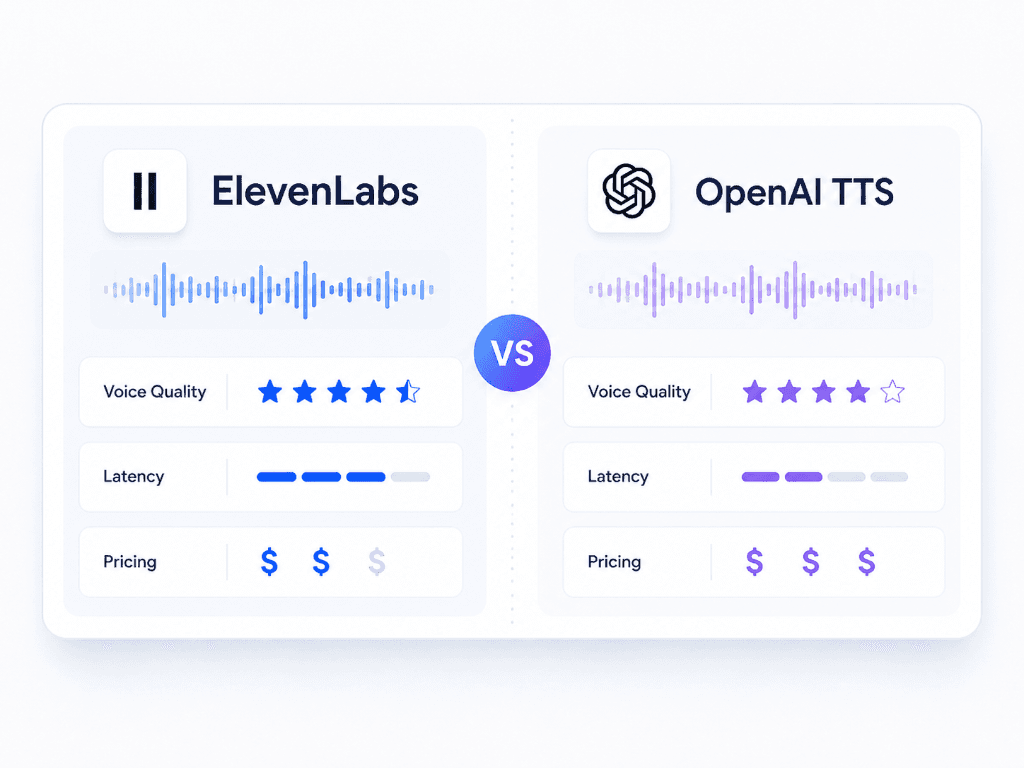
If you're building anything that speaks - a voiceover pipeline, an accessibility layer, a conversational agent, a podcast tool - you've probably narrowed it down to ElevenLabs and OpenAI. They're the two names that come up first in every Discord thread, every Hacker News comment section, every "best TTS API" listicle.
But comparing them is harder than it looks, because they don't price the same way, they don't optimise for the same thing, and the right answer depends entirely on what you're building. This article lays out the actual numbers - pricing, quality scores, latency benchmarks, feature differences - so you can make the call without guessing.
Pricing: OpenAI is roughly 13× cheaper
This is the single biggest differentiator, and it isn't close.
OpenAI charges $0.015 per 1,000 characters for tts-1, their standard model. That's pay-as-you-go, no commitment, no monthly minimum. You send characters, you pay for characters. The higher-fidelity tts-1-hd model costs $0.030 per 1,000 characters.
ElevenLabs uses subscription tiers with monthly character quotas. On the Starter plan ($6/month), you get 30,000 characters - which works out to about $0.200 per 1,000 characters. On the Creator plan ($22/month), you get 121,000 characters, bringing the effective rate down to $0.182 per 1,000 characters. Scale and Business tiers bring it lower still, but even at enterprise volume, ElevenLabs remains meaningfully more expensive per character than OpenAI.
For a concrete example: converting a 5,000-word article (~25,000 characters) would cost about $0.38 with OpenAI and roughly $5.00 with ElevenLabs at Starter rates. At volume, that difference compounds fast.
Pricing model matters. OpenAI's pay-as-you-go model means you only pay for what you use. ElevenLabs' subscription model means unused characters expire at the end of the month. If your usage is bursty or unpredictable, PAYG is usually safer. If you know your volume precisely, subscriptions can offer better unit economics at higher tiers.
See the full breakdown on our OpenAI pricing page and ElevenLabs pricing page.
Voice quality: ElevenLabs leads, but OpenAI is improving
ElevenLabs has consistently ranked at or near the top of blind listening tests. In the TTS Arena benchmark (an Elo-style rating system where listeners pick between unlabelled audio samples), ElevenLabs scores around 4.5 out of 5 - the highest of any commercial API.
OpenAI's standard tts-1 model scores approximately 3.8 out of 5. It's perfectly functional - clear, consistent, intelligible - but it lacks the natural breathing patterns, micro-inflections, and emotional range that make ElevenLabs voices sound closer to a human recording. The HD variant tts-1-hd closes the gap somewhat, scoring around 4.1 out of 5, but doubles the per-character cost.
The practical implication: if your users are listening passively - audiobook narration, long-form podcasts, guided meditations - they'll notice the difference. If your use case is transactional - reading out alerts, confirmation messages, navigation directions - the quality gap matters far less.
Latency: ElevenLabs has a slight edge
Both providers stream audio, so you hear the first chunk before the full request finishes. But time-to-first-byte matters a lot in conversational applications where every 100ms of silence feels unnatural.
ElevenLabs reports time-to-first-byte of approximately 180ms, which is impressively fast - particularly with their Turbo v2.5 model optimised for low-latency use cases like real-time assistants.
OpenAI's tts-1 comes in at roughly 300ms, and tts-1-hd at around 350ms. Neither is slow in absolute terms, but for voice agents where the AI needs to respond mid-conversation, that 120ms gap is perceptible.
For batch processing - generating audiobook chapters, pre-rendering podcast episodes, creating video narration - latency is irrelevant. Both providers will process your text faster than you can listen to it.
Language support: OpenAI covers more ground
OpenAI supports approximately 50 languages, broadly matching the language set available through Whisper (their speech-to-text model). This includes less-common languages that many TTS providers skip entirely.
ElevenLabs supports 32 languages as of mid-2026, with strong coverage across European and major Asian languages, but gaps in some African and South Asian languages.
If your product needs to serve users in Thai, Swahili, or Uzbek, check the specific language lists before committing. OpenAI's broader coverage might save you from having to integrate a second provider.
Voice cloning: ElevenLabs only
This is a clear binary. ElevenLabs offers instant voice cloning (upload a short sample, get a usable clone in minutes) and professional voice cloning (higher fidelity, requires more training data and verification). Both are available through the API.
OpenAI does not offer any form of voice cloning. You choose from a fixed set of pre-built voices (Alloy, Echo, Fable, Onyx, Nova, and Shimmer). They sound good - several of them are genuinely pleasant - but you can't create a custom voice that matches your brand, your founder's voice, or a specific character.
If custom voices are a requirement - and for many products they are - this alone might settle the decision.
Head-to-head comparison
| Feature | OpenAI TTS | ElevenLabs |
|---|---|---|
| Price / 1K chars | Cheapest$0.015 | $0.182 – $0.200 |
| Pricing model | Pay-as-you-go | Monthly subscription |
| Voice quality | 3.8 – 4.1 / 5 | 4.5 / 5 |
| Latency (TTFB) | ~300 – 350ms | ~180ms |
| Languages | ~50 | 32 |
| Voice cloning | No | Yes (instant + pro) |
| Voices available | 6 built-in | Thousands + custom |
| Free tier | No (credit-based) | Free10,000 chars/mo |
| SSML support | No | Partial |
| Streaming | Yes | Yes |
Use our main calculator page to compare OpenAI and ElevenLabs costs for your specific text inputs.
Pricing models: why this matters more than the headline rate
The raw per-character price doesn't tell the full story. The structure of the pricing model affects your effective cost depending on how you actually use the API.
OpenAI's pay-as-you-go model is straightforward: you load credits, you consume them. No monthly commitment, no expiring quotas. This works well for prototyping, for apps with unpredictable usage, or for any situation where you don't want to forecast demand.
ElevenLabs' subscription model gives you a fixed character allocation each month. Use it or lose it. If you consistently hit your quota, the effective rate is predictable and budgetable. If you underuse it, you're paying for idle capacity. If you exceed it, you'll need to upgrade mid-cycle or wait until the next billing period.
For startups with volatile usage or side projects with occasional spikes, PAYG eliminates waste. For production systems with steady, predictable TTS volume - say, a content platform that converts every article to audio - the subscription model is at least plannable, even if it's more expensive per character.
When to use each provider
Choose OpenAI when…
- ✓Cost is the primary constraint and you need volume
- ✓You need broad multilingual coverage (50+ languages)
- ✓You're already using the OpenAI API and want one vendor
- ✓Your use case is transactional: alerts, notifications, UI narration
- ✓You want simple PAYG billing with no quotas or commitments
Choose ElevenLabs when…
- ✓Audio quality is non-negotiable (audiobooks, podcasts, brand voice)
- ✓You need voice cloning - there is no workaround for this
- ✓Your application is real-time and every millisecond of latency counts
- ✓You want a large library of pre-made voices to choose from
- ✓You're building a consumer product where voice is the experience
The hybrid approach
Plenty of teams use both. The pattern that keeps recurring in production architectures: use ElevenLabs for the high-value, user-facing audio (the main podcast feed, the hero voiceover, the branded greeting) and fall back to OpenAI for everything else (bulk narration, internal tools, automated reports, lower-priority content).
This gives you the quality ceiling of ElevenLabs where it matters and the cost floor of OpenAI where it doesn't. The integration overhead of maintaining two providers is minimal - both have clean REST APIs with similar interfaces.
The bottom line
There is no universal "better" provider here. OpenAI wins on price - and wins decisively. ElevenLabs wins on voice quality, latency, and flexibility. The decision rests on what you're optimising for.
If cost is the binding constraint and your users aren't listening critically, OpenAI at $0.015/1K characters is hard to argue with. If the voice isthe product, ElevenLabs justifies the premium. And if you're unsure, start with OpenAI - the lower cost makes experimentation cheap - and switch specific use cases to ElevenLabs if and when quality becomes a bottleneck.
Calculate your actual costs
Paste your text into the calculator and see exactly what OpenAI, ElevenLabs, and every other provider would charge - side by side, with quality and latency scores.
Open the TTS Calculator →