Chained TTS vs. OpenAI Realtime & GPT-Live: 2026 Cost Guide
OpenAI recently shook up the voice space with the release of the updated gpt-realtime-2.1 and the full-duplex GPT-Live-1 models. But for developers building voice applications, a critical economic question looms: Is it better to pay the premium for a native speech-to-speech model, or stick to a chained STT + LLM + TTS pipeline? We ran the numbers.
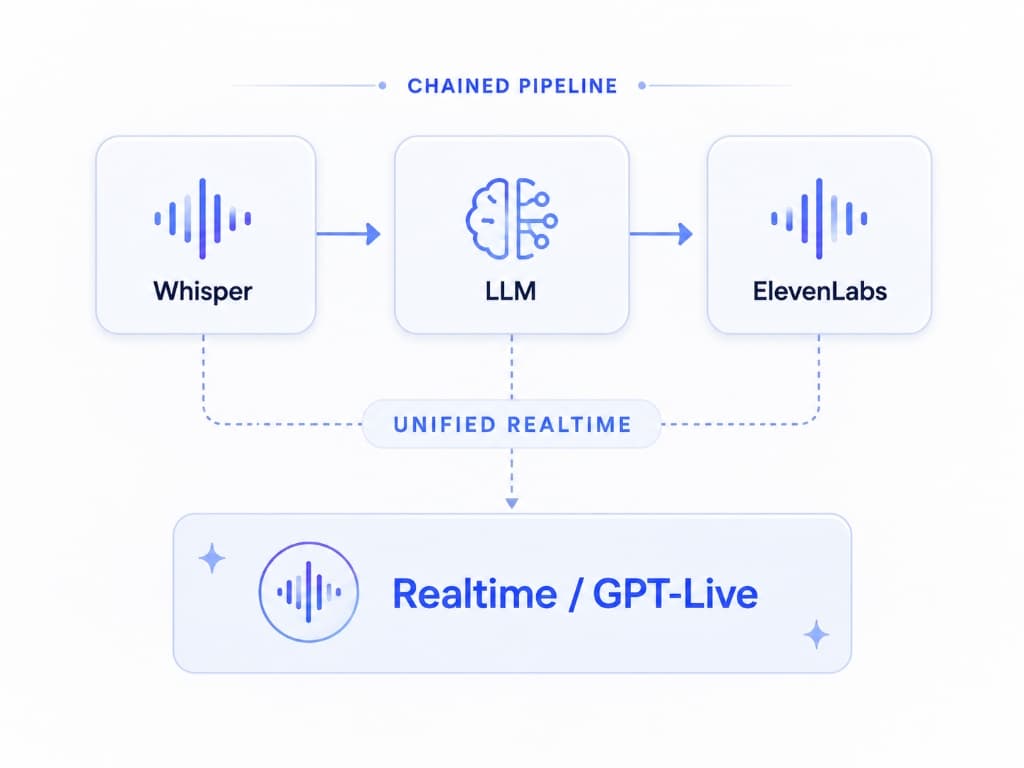
For years, the standard way to build a voice assistant or interactive system was a modular pipeline. You chained three separate APIs together: a speech-to-text transcriber (like OpenAI Whisper), a text-based LLM (like GPT-4o-mini), and a text-to-speech engine (like Cartesia Sonic or ElevenLabs).
With the advent of native audio-in/audio-out models, culminating in the recent July 2026 launch of OpenAI's Realtime 2.1 API and GPT-Live-1 models, this chained pipeline can now be consolidated into a single API call. This eliminates the latency overhead of chaining and yields highly natural conversations with organic intonations.
However, this luxury comes with a steep price tag. Because real-time models bill by the audio token rather than by character count or flat minutes, standard cost comparisons can be hard to decipher. In this guide, we break down the pricing models, translate tokens to characters, and show you exactly what each approach costs.
The Bottom Line: Cost Per Minute
To compare these approaches fairly, we calculated the cost of a 1-minute voice conversation. We assume standard speaking rates: 150 words spoken by the user (audio input) and 150 words generated by the AI (audio output).
| Architecture Stack | Pricing Models Used | Cost Per Min | Price Factor |
|---|---|---|---|
| Chained Stack (Budget) Whisper STT + gpt-4o-mini + Google Standard | Whisper ($0.006/min) + LLM ($0.0001) + Google TTS ($4/1M chars) | ~$0.009 | Cheapest |
| Chained Stack (Premium) Whisper STT + gpt-4o-mini + Cartesia Sonic 3.5 | Whisper ($0.006/min) + LLM ($0.0001) + Cartesia ($50/1M chars) | ~$0.044 | 1.0x (Baseline) |
| OpenAI Realtime Mini gpt-realtime-2.1-mini | Audio In ($10.00/1M tokens) + Audio Out ($20.00/1M tokens) | ~$0.180 | 4.1x premium |
| OpenAI Realtime Standard gpt-realtime-2.1 | Audio In ($32.00/1M tokens) + Audio Out ($64.00/1M tokens) | ~$0.570 | 13.0x premium |
Understanding the Math
Standard text-based models bill by character or text token. Realtime audio models bill by audio tokens. OpenAI maps 1 second of audio output to approximately 100 audio tokens. This means:
- Audio Input: A 1-minute conversation contains roughly 30 seconds of user speech, costing ~3,000 input tokens. At $10/1M tokens for `gpt-realtime-2.1-mini`, this equals $0.06 / minute.
- Audio Output: Generating 30 seconds of spoken AI audio uses ~3,000 output tokens. At $20/1M tokens, this equals $0.12 / minute.
- Total cost: Combining input and output yields $0.18 per minute.
For standard `gpt-realtime-2.1`, the numbers scale up quickly. Input audio at $32/1M tokens costs $0.19 per minute, and output audio at $64/1M tokens costs $0.38 per minute. Total cost: $0.57 per minute.
How the Chained Pipeline Saves 90%
By comparison, the modular pipeline bills elements separately:
- STT (Whisper API): Flat-rate billing of $0.006 per minute.
- LLM (GPT-4o-mini): Input and output tokens are text-only, which are extremely cheap ($0.15/1M in, $0.60/1M out). In a 1-minute conversation, this cost is negligible (under $0.0002).
- TTS (Cartesia Sonic 3.5): Billed per character. Standard pricing is $50 per million characters. A typical speaking rate generates ~750 characters of output per minute, which translates to $0.0375 per minute.
Adding those components up results in a total of $0.0437 per minute. That is less than a quarter of the price of the Realtime Mini API and a fraction of the cost of standard Realtime.
Latency: The 13x Premium Justification
If the chained stack is 4x to 13x cheaper, why would anyone use the Realtime API? The answer lies in **latency** and **conversational feel**:
⏱️Chained Stack Latency
- • Speech-to-Text: 200ms–300ms
- • LLM TTFB (Time to First Token): 150ms–250ms
- • Text-to-Speech TTFB: 80ms–150ms
- • Total End-to-End Latency: 600ms–900ms
- Result: Feels like a walkie-talkie. Users notice the delay.
⚡Realtime API Latency
- • Unified Audio-in/Audio-out: ~250ms
- • Interruption handling: Instant (under 100ms)
- • Dynamic prosody & breath cues: Native
- • Total End-to-End Latency: 200ms–300ms
- Result: Feels like a natural human telephone call.
Chained pipelines suffer from "compounding latency." The text LLM has to wait for STT to finish transcribing, and the TTS engine has to wait for the LLM to generate at least a clause. Realtime models bypass this staging entirely.
The Decision Matrix: Which to Choose?
Use a Chained Stack if:
- You are building one-way narration (e.g. converting blog posts to audio, e-learning voices, audiobook narration).
- Your app allows for a brief pause (e.g. reading out a smart home confirmation, virtual assistant with visual feedback).
- You are running on a tight startup budget where 13x infrastructure markups would kill unit economics.
Use OpenAI Realtime / GPT-Live if:
- You are building **interactive voice bots** (e.g., customer service call agents, AI tutoring companions, language practice apps).
- User experience hinges entirely on low latency and conversational flow.
- Natural interruption is a hard requirement (users need to be able to talk over the bot mid-sentence).
Conclusion
While unified audio APIs like OpenAI Realtime 2.1 represent the future of conversational AI, they are still priced as premium developer tools. For the vast majority of traditional text-to-speech workloads, modular pipelines utilizing fast TTS providers like Cartesia Sonic 3.5 remain the dominant option, delivering comparable quality at a 90% discount.
Before committing to a architecture, prototype both. Measure user churn at 800ms latency vs. 300ms latency, and weigh it against your projected user base. Often, starting with a chained stack using a fast TTS engine is the most sensible way to bootstrap your voice application.
Want to compare character-based pricing across 7 leading providers?
Go to TTS Cost Calculator →