TTS Pricing Models Explained: Pay-as-You-Go vs Subscriptions
Every text-to-speech API uses one of two pricing models. One charges per character and never wastes a penny. The other sells monthly quotas at a fixed fee - and quietly charges you for characters you never generate. The wrong choice can double your effective cost.
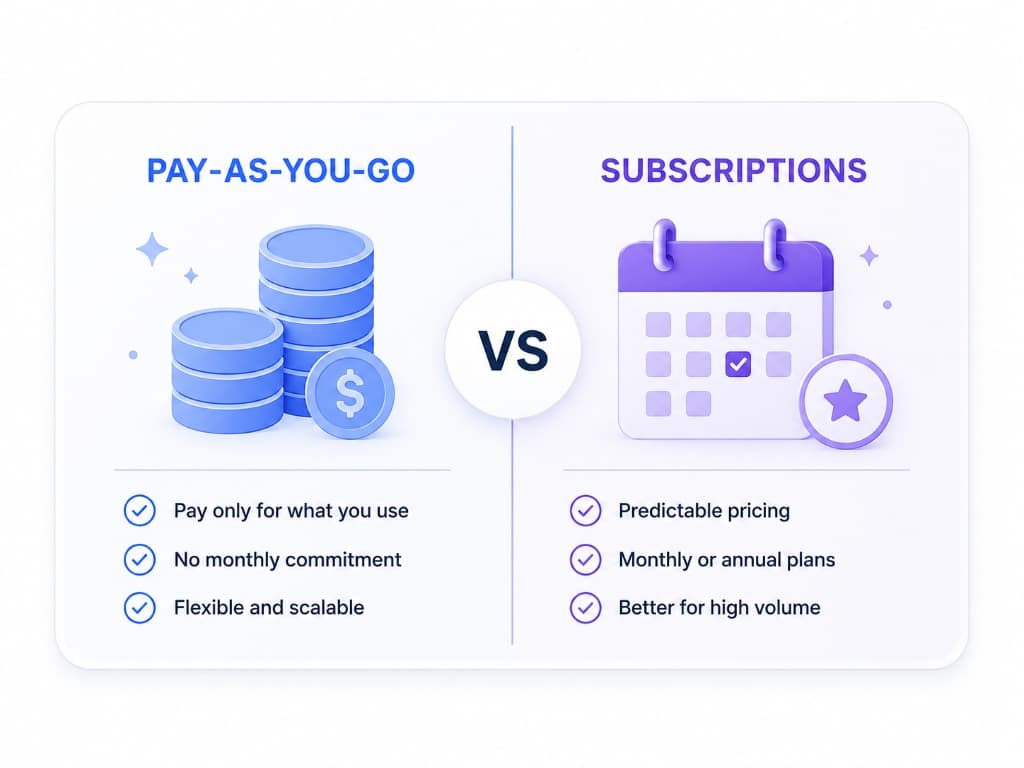
The two pricing models
Text-to-speech APIs fall into two camps. The distinction matters more than most people think, because the pricing model you choose affects your cost at every usage level - not just at the margins.
Pay-as-you-go (PAYG)
You send characters to the API, you pay for those characters. No monthly fee, no commitment, no quota to manage. If you generate zero characters in a month, you pay zero. This is the model used by OpenAI ($0.015/1K chars), Google Cloud TTS ($0.004–$0.016/1K), Amazon Polly ($0.004–$0.030/1K), Azure ($0.016/1K), Deepgram ($0.030/1K), and Cartesia ($0.050/1K).
Subscription (quota-based)
You pay a fixed monthly fee and receive a character allowance. Use it or lose it - unused characters expire at the end of each billing cycle. ElevenLabs is the main TTS provider using this model: $6/month for 30,000 characters (Starter) or $22/month for 121,000 characters (Creator).
PAYG vs Subscription at a glance
| Pay-as-you-go | Subscription | |
|---|---|---|
| Billing | Per character used | Fixed monthly fee |
| Commitment | None | Monthly |
| Unused chars | N/A - you don't pre-buy | Expire at month end |
| Cost floor | $0 if idle | $6/mo minimum |
| Overage | Same rate - no surprises | Must upgrade tier |
| Providers | OpenAI, Google, Amazon, Azure, Deepgram, Cartesia | ElevenLabs |
The hidden cost of subscriptions: quota waste
On paper, ElevenLabs Starter costs $0.20 per 1,000 characters ($6 ÷ 30,000 chars). That's the nominalrate. But it's only your actual rate if you use every single character in your monthly quota.
Use half? Your effective cost per 1,000 characters doubles to $0.40. Use a quarter and it's $0.80. The subscription fee stays the same regardless, so every unused character raises the price of the ones you did generate.
| Quota used | Chars generated | You still pay | Effective cost/1K |
|---|---|---|---|
| 100% | 30,000 | $6 | $0.20 |
| 80% | 24,000 | $6 | $0.25 |
| 50% | 15,000 | $6 | $0.40 |
| 25% | 7,500 | $6 | $0.80 |
| 10% | 3,000 | $6 | $2.00 |
The maths are simple: Effective cost per 1K = Monthly fee ÷ Characters actually used × 1,000. At 50% utilisation, you're paying 2× the advertised rate. At 25%, it's 4×. This is the cost that never appears on the pricing page.
When subscriptions actually win
Subscriptions aren't inherently worse - they're worse when usage is unpredictable. If your usage is stable and consistently hits 80% or more of your quota, a subscription can be the smarter choice. Here's why:
- •Predictable billing. You know exactly what you'll spend each month. No surprises from a traffic spike.
- •Better voice quality. ElevenLabs scores 4.5/5 on quality benchmarks - the highest of any provider in our data. If voice quality is non-negotiable, the subscription model is the price of admission.
- •Bundled features. ElevenLabs subscriptions include voice cloning, the Projects tool, and commercial usage rights that PAYG providers may charge separately for.
When pay-as-you-go wins
PAYG is the better model for the majority of use cases. Specifically:
- •Variable or unpredictable usage. If your TTS volume swings week to week - say, processing user-submitted text in an app - a subscription means paying for peaks you rarely hit.
- •Low volume. Generating under 30,000 characters per month? With OpenAI at $0.015/1K, that's $0.45 total - compared to $6.00 for ElevenLabs Starter. You'd need to generate 400,000 characters with OpenAI tts-1 before the cost reaches $6.
- •Experimentation and prototyping. Testing different providers, building an MVP, or running a proof of concept. PAYG lets you stop at any time with no ongoing cost.
- •Budget ceiling control. With Google Standard at $0.004/1K, you can generate 1 million characters for $4. That's roughly 170 hours of spoken audio for less than the cost of a coffee.
The overage trap
With PAYG providers, going over your expected usage just means a higher bill at the same per-character rate. There's no penalty - the unit economics stay constant.
Subscription models work differently. With ElevenLabs, when you exhaust your 30,000-character Starter quota, you can't just keep generating at $0.20/1K. You have to either wait for your quota to reset next month, or upgrade to the Creator plan at $22/month. That's a 267% price jump for any amount of overage - even a single extra character.
This creates a cliff in the cost curve. A PAYG provider's cost scales linearly. A subscription provider's cost jumps in discrete steps, and those steps are large enough to be painful.
The breakeven calculation
At what usage level does a subscription become cheaper than paying per character? Let's compare ElevenLabs Starter ($6/mo, 30K chars) against three PAYG providers:
| PAYG Provider | Rate/1K chars | Cost for 30K chars | Breakeven vs ElevenLabs ($6) |
|---|---|---|---|
| Google Standard | $0.004 | $0.12 | 1,500,000 chars |
| OpenAI tts-1 | $0.015 | $0.45 | 400,000 chars |
| Cartesia Sonic | $0.050 | $1.50 | 120,000 chars |
The breakeven formula: Monthly fee ÷ PAYG rate per character. For OpenAI: $6 ÷ $0.000015 = 400,000 characters. You'd need to generate 400K characters every single month for the ElevenLabs subscription to match OpenAI on cost alone - and that's more than 13× the Starter quota.
Key insight: ElevenLabs doesn't compete on price. It competes on voice quality (4.5/5 vs 3.8/5 for OpenAI) and features like voice cloning. If those aren't requirements for your project, the PAYG providers will be 10–50× cheaper at any usage level.
Decision framework: which model should you pick?
Walk through these questions in order. The first “yes” gives you your answer.
1. Do you need ElevenLabs-specific features (voice cloning, Projects, specific voices)?
→ Subscription is your only option. Pick the tier that covers your average monthly usage at 80%+ utilisation.
2. Is your monthly usage under 30,000 characters?
→ PAYG. At this volume, every PAYG provider is cheaper than the $6/mo Starter plan. OpenAI would cost $0.45 total.
3. Does your usage vary by more than 2× month to month?
→ PAYG. Variable usage guarantees quota waste in low months and overage pressure in high months.
4. Are you prototyping, testing, or evaluating providers?
→ PAYG. Zero commitment, zero waste. Most providers offer free tiers (Google: 4M chars/mo, Amazon: 5M chars for 12 months, Deepgram: $200 credit).
5. Do you have stable, predictable, high-volume usage (100K+ chars/mo)?
→ Run the numbers. Compare your monthly volume × the PAYG rate against the subscription fee. If the subscription is cheaper and you consistently hit 80%+ quota, it wins.
Real-world cost comparison
To make this concrete, here's what three common workloads actually cost across models:
| Use case | Chars/month | OpenAI tts-1 | Google Standard | ElevenLabs |
|---|---|---|---|---|
| Blog narration (5 posts) | 25,000 | $0.38 | $0.10 | $6.00 (Starter) |
| App notifications | 100,000 | $1.50 | $0.40 | $22.00 (Creator) |
| Audiobook (full novel) | 500,000 | $7.50 | $2.00 | $99.00 (Scale) |
The gap is stark. For the blog narration use case, Google Standard costs 60× less than ElevenLabs. Even at audiobook scale, OpenAI is 13× cheaper. The subscription model only makes economic sense when you're paying for quality and features that PAYG providers don't offer - and when you can consistently hit your quota.
The bottom line
Most teams default to ElevenLabs because the voice quality is genuinely excellent. That's a valid reason. But it's worth understanding what you're actually paying for. If you're using 50% of your ElevenLabs quota, you're paying $0.40 per 1,000 characters - 100× more than Google Standard and 27× more than OpenAI.
The pricing model isn't a minor detail. For most projects, it's the single biggest factor in your total cost. Run the numbers with your actual usage before you commit.
See what your project will actually cost
Enter your character count and compare every provider side-by-side - PAYG and subscription models included.
Open the Calculator →